Patron of Lebanon, the Family, and Priests.
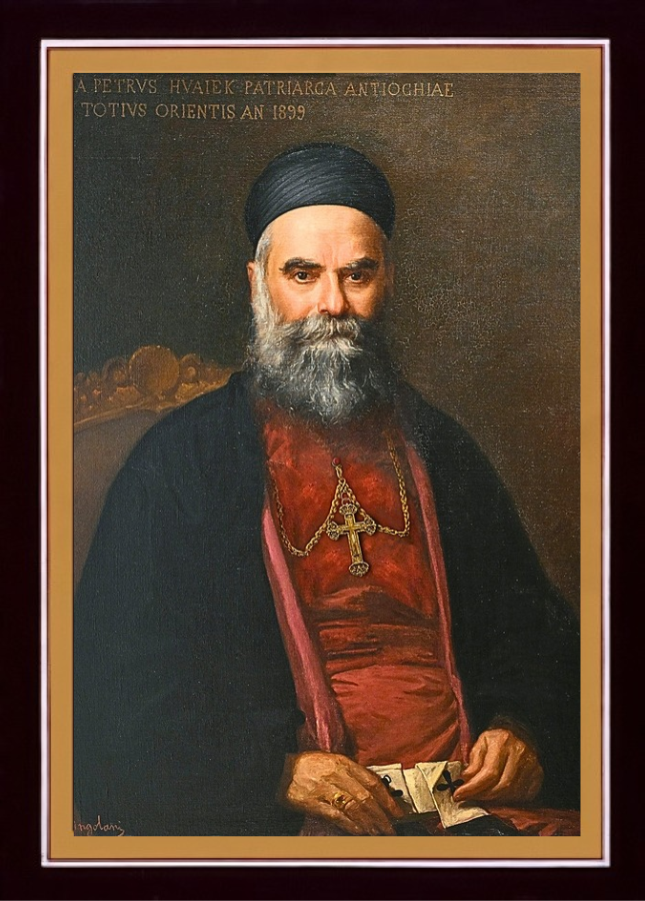
Patriarch Elias Boutros Howayek, Patriarch of Antioch and All the East (1899–1931), is a man of fervent love for God, reaching mysticism and absolute filial surrender to Divine Providence. He is a man of prayer and fidelity, a man of integrity and humility, a defender of the poor and the oppressed, a man of limitless mercy and apostolic zeal, the teacher and reformer, a man of prophetic vision, and the founder of the Congregation of the Maronite Sisters of the Holy Family.
Elias was born in December 1843 in the Batroun village of Helta in North Lebanon. He first learned under the oak tree of the village, then moved in 1851 to the seminary of Kfarhay, and from there to the seminary of Ghazir. He then traveled to Rome in 1866 to pursue his theological studies at the College of the “Propagation of the Faith.”
He was ordained a priest on June 5, 1870, in the Church of the Sacred Heart at Villa Lante – Rome. On August 9 of the same year, he obtained his Doctorate in Theology. After his return to Lebanon, he stayed for a short time in his village, Helta, plowing the land to pay off the debts that his father had left upon his shoulders after his passing. Then Patriarch Paul Massad sent him to teach moral theology at the seminary of Kfarhay. In June 1872, he appointed him Secretary of the Patriarchate in Bkerke and Defender of the Bond (of marriage) in the Patriarchal Tribunal.
On December 14, 1889, he was ordained titular Bishop of Arqa and Patriarchal Vicar. In the year 1895, he founded the Congregation of the Maronite Sisters of the Holy Family, to be at the service of humanity, the family, and society, according to the needs of the times.
In the year 1899, he was elected Patriarch of Antioch and All the East. Over the course of thirty-two years, his apostolic, pastoral, social, and national zeal manifested in his deeds. He built numerous shrines, churches, and monasteries, including the Patriarchal See in Dimane, and reopened the Maronite College in Rome for the formation of priests. On May 3, 1908, he inaugurated the Shrine of Our Lady of Lebanon in Harissa, consecrating the country to the Virgin Mary and placing it under her protection. In 1916, he ordered that the doors of the Patriarchal See, and the doors of the monasteries, be opened to the victims of the famine that swept the country during the First World War.
In 1919, and after gaining the trust of all Lebanese, he represented Lebanon at the League of Nations in Versailles, demanding the independence of the country. On the first of September 1920 and in his presence, General Gouraud declared the State of Greater Lebanon. By his order, and with the assistance of Abbot Ignatius Tannouri, a committee dedicated to examining the reputation of sanctity of Father Nimatullah Hardini, Father Charbel Makhlouf, and the nun Rafqa al-Rayes was formed. He also directly requested His Holiness the Pope to declare the three Massabki Maronites—Francis, Abdel Moati, and Raphael—as Blessed, and he obtained what he desired on October 10 of the year 1926.
On Christmas night of the year 1931, he fell asleep in peace and entered the House of the Father, to whom he had consecrated his life, his love, his vitality, his projects, his achievements, and all the filial desires of his soul. The bells of Bkerke and Lebanon tolled, and the people rushed to receive blessings from his pure body, repeating: "The Saint Patriarch has died."
From that moment, many received graces and healings through his intercession, which were documented by the archives of the Congregation of the Maronite Sisters of the Holy Family in preparation for submitting his cause of canonisation to the Congregation for the Causes of Saints in Rome. Many circumstances delayed the submission of this file, most notably the consecutive wars that Lebanon lived through. However, Divine Providence has its own view in the administration of history.
In the year 2010, the Congregation of the Maronite Sisters of the Holy Family began submitting the file of his canonisation and appointed me to follow up on the file as the Postulator for the cause before the Holy See. On July 6, 2019, His Holiness Pope Francis signed the decree declaring the Father Founder as Venerable. This declaration coincided with the opening of the first centenary of the declaration of the State of Greater Lebanon, the fruit of the sacrifices, efforts, and prayers of Patriarch Elias.
A few months after the declaration of veneration, the investigation works began regarding a grace of healing attributed to the Venerable Patriarch Elias Howayek, which was received by a soldier from the Lebanese Army, from Hasbaya – the South, from the Druze community, who suffered from an incurable herniation in the vertebrae of his spine that was gradually paralysing his movement. After the approval of the Medical Board (on June 5, 2025) and theologians (on October 17, 2025), and the Congregation of Cardinals and Bishops in the Dicastery for the Causes of Saints on the validity of the miracle (on May 19, 2026), His Holiness Pope Leo XIV signed on May 22, 2026, the validity of the miracle attributed to his intercession, and then approved appointing July 25, 2026, as the date for the celebration of his declaration as Blessed.
On this holy day in the history of Lebanon and the Maronite Church, we raise our prayer, a prayer of thanksgiving to the Father for His care for His little flock, and we ask Him to always send us shepherds after His own heart, working according to His good pleasure, just as the Blessed Patriarch Mar Elias Boutros Howayek lived and died.