
The Liturgical Year, also known as the Church Year or Ecclesiastical Calendar, traces the Church’s journey towards the Kingdom of God. It encompasses the events of Jesus’ life, death, and Resurrection, the feast days of the saints, Holy Days of Obligation, and the Scripture passages appointed for each celebration.
Unlike the calendar year, which runs from January to December and is divided into four seasons, the Maronite Liturgical Year runs from November to October and consists of seven seasons.
The first season is the Season of the Glorious Birth of Our Lord, which focuses on the announcements and events leading up to the Nativity. It begins on the first Sunday of November with the Sunday of the Consecration and Renewal of the Church.
The second season is the Season of the Glorious Epiphany. It begins on January 6 with the Feast of the Epiphany, which commemorates the Baptism of Jesus and the beginning of His public ministry.
This season includes the three Commemoration Sundays: the remembrance of departed priests, the Righteous and Just (the Maronite equivalent of All Saints’ Day), and all the Faithful Departed (similar to All Souls’ Day).
The third season is Great Lent. It begins with Cana Sunday, followed by Ash Monday, which marks the beginning of fasting. The season concludes with the Friday of the Temptation of Jesus in the wilderness, the fortieth day of Lent, followed immediately by Lazarus Saturday and Hosanna Sunday (Palm Sunday).
The evening of Hosanna Sunday marks the beginning of the fourth and shortest season, Passion Week. It begins with the Rite of the Arrival at the Harbour and continues with the Rite of the Lamp on Passion Wednesday, the Rite of the Washing of the Feet on Thursday of the Mysteries, the Adoration of the Cross on Great Friday, and Saturday of the Light.
The fifth season is the Season of the Glorious Resurrection, which recounts the appearances of the Risen Lord Jesus to His apostles.
The sixth season is the Season of Pentecost, which is the longest season of the Maronite Liturgical Year.
The seventh and final season is the Season of the Glorious Cross. It focuses on Christ’s Second Coming and calls the faithful to prepare for their departure from this earthly life towards their heavenly home.
The Liturgical Year is not simply a repetition of feasts or traditions. It is a journey towards God. It draws believers closer to the Father, teaching them how to love and serve Him in this life so that they may be united with Him forever in the next.
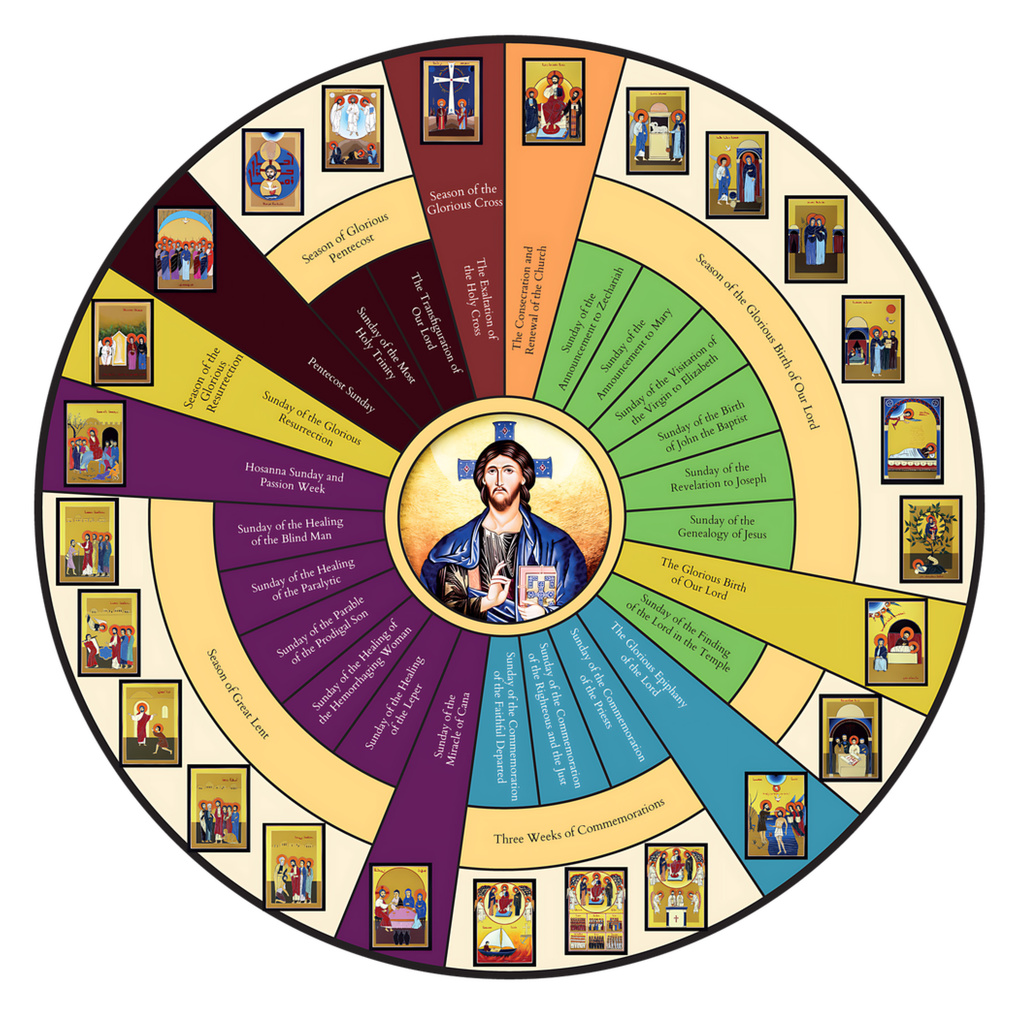
Maronite Catholic Lectionary by Dr Margaret Ghosn
The Seasons of the Liturgical Year in both the Roman Catholic and Maronite Catholic Churches
| Seasons in the Church | |
|---|---|
| Roman Catholic | Maronite Catholic |
| Sundays of the Church (1–2 weeks) | |
| Advent (4 weeks) | Season of the Glorious Birth of the Lord (7 weeks, including Christmas) |
| Christmas and Epiphany (2 weeks) | |
| Season of Epiphany, including the three Commemoration Sundays (1–7 weeks) | |
| Ordinary Time I (6–8 weeks) | |
| Lent (6 weeks) | Season of Great Lent (7 weeks) |
| Triduum (3 days): Holy Thursday, Good Friday, Holy Saturday | Passion Week |
| Easter (8 weeks) | Season of the Glorious Resurrection (7 weeks) |
| Pentecost Sunday (1 week) | Season of Pentecost (up to 18 weeks) |
| Ordinary Time II | |
| Season of the Glorious Cross (7 weeks) | |
Cycles of the Lectionary
The Maronite Catholic Lectionary cycle assigns Scripture readings to the seasons and feasts of the Church Year. These readings reflect the literary and historical context of Scripture in ways that are appropriate to each liturgical season.
From the time of the Crusades through to the 16th century and beyond, contact with the Western Church influenced the Maronite Church and led to a period of Latinisation. Following the Second Vatican Council in the 1960s, the Maronite Church was encouraged to renew and restore its authentic liturgical traditions.
The Patriarchal Liturgical Commission and the Institute of Liturgy began the restoration of the authentic Maronite Liturgy. This work included the revision of the Divine Liturgy in 1992, followed by the revision of the Lectionary in 1993.
The Maronite Lectionary follows a one-year cycle. It presents one reading from Christian Scripture, taken from the Epistles, the Acts of the Apostles, or the Book of Revelation. The daily readings follow a theme that continues throughout the Sunday celebration and the following week.
This reading is followed by a Gospel passage taken from one of the four Evangelists, continuing the same theme presented in the first reading. Because only selected passages from each Gospel are included, the yearly cycle is sometimes described as repetitive from year to year.
During the Patriarchal Maronite Synod (2003–2006), consideration was given to introducing a second reading from the Hebrew Scriptures to further highlight the richness of the Word of God. This has not yet been implemented.
The Seasons and Gospel Passages Used in the Maronite Catholic Lectionary
| Season | Gospel Passages |
|---|---|
| Consecration and Renewal of the Church (1–2 weeks) | Consecration of the Church – Mt 16:13–20 Renewal of the Church – Jn 10:22–42 |
| Season of the Glorious Birth of the Lord (7 weeks) | Announcement to Zechariah – Lk 1:1–25 Announcement to Mary – Lk 1:26–38 Visitation of Mary – Lk 1:39–45 Birth of John the Baptist – Lk 1:57–66 Revelation to Joseph – Mt 1:18–25 Genealogy of Jesus – Mt 1:1–17 Birth of the Lord – Lk 2:1–20 Finding of Jesus in the Temple – Lk 2:41–52 |
| Season of Epiphany (including the three Commemoration Sundays) | Weeks of Epiphany Sunday of the Deceased Priests – Lk 12:42–48 Sunday of the Righteous and Just – Mt 25:31–36 Sunday of the Faithful Departed – Lk 16:19–31 |
| Season of Great Lent and Passion Week (7 weeks) | Cana Sunday – Jn 2:1–11 Ash Monday Healing of the Leper – Mk 1:35–45 Healing of the Haemorrhaging Woman – Lk 8:40–56 Parable of the Lost Son – Lk 15:11–32 Healing of the Paralytic – Mk 2:1–12 Healing of the Blind Man – Mk 10:46–52 Palm Sunday and Passion Week – Jn 12:12–22 |
| Season of the Glorious Resurrection (7 weeks) | Resurrection Sunday – Mk 16:1–8 New Sunday |
| Season of Pentecost (up to 18 weeks) | Sunday of Pentecost – Jn 14:15–20 Holy Trinity Sunday – Mt 28:16–20 Followed by up to 16 weeks focusing on the Spirit and Mission: Fifth Sunday – Calling of the Disciples – Mt 10:1–7 Sixth Sunday – Sending of the Disciples – Mt 10:16–25 Seventh Sunday – Sending of the Seventy-Two Disciples – Lk 10:1–7 Eighth Sunday – Spirit of the Disciples – Mt 12:14–21 Ninth Sunday – Mission of the Disciples – Lk 4:14–21 |
| Season of the Glorious Cross (7 weeks) | Feast of the Exaltation of the Cross – Jn 12:20–32 First Sunday after the Feast – Sons of Zebedee – Mk 10:35–45 Second Sunday – Persecutions – Mt 24:1–14 Third Sunday – False Signs – Mt 24:23–31 Fourth Sunday – Good and Bad Servants – Mt 24:45–51 Fifth Sunday – Ten Bridesmaids – Mt 25:1–13 Sixth Sunday – The Talents – Mt 25:14–30 Seventh Sunday – Feast of Jesus the King – Mt 25:31–46 |
Preparation for Christmas
The Maronite Lectionary begins in November. Depending on when the first Sunday falls in the month, the Dedication of the Church may last one or two weeks. These Sundays focus on the Consecration and Renewal of the Church. If the first Sunday falls early in November, two Sundays are dedicated to the Church. If the first Sunday falls later in November, both the Consecration and Renewal of the Church are celebrated during the first week.
Following this period, the official Liturgical Seasons begin. In both the Roman Catholic and Maronite Catholic Lectionaries, the liturgical year begins with a season of preparation for Christmas.
In the Maronite Lectionary, the Season of the Glorious Birth of the Lord begins immediately after the week or weeks dedicated to the Church. The Sunday Gospel readings recount, week by week, the announcements leading to the Birth of Christ. These include the Annunciation to Zechariah, the Annunciation to Mary, and the Revelation to Joseph. Before entering the Season of Epiphany, the final Sunday focuses on the Finding of Jesus in the Temple.
The Season of Epiphany
Following the Season of the Glorious Birth, the Maronite Catholic Church celebrates the Season of Epiphany, beginning on January 6. In the Eastern Churches, Epiphany commemorates the Baptism of Jesus. In contrast, the Roman Catholic Church celebrates Epiphany as the visit of the Magi and their offering of gifts to the Child Jesus, while the Sunday following January 6 commemorates the Baptism of the Lord.
The meaning of Epiphany, as a manifestation or revelation of Christ, is shared by both Eastern and Western Christian traditions. In the Maronite Lectionary, the Season of Epiphany lasts between one and seven weeks, depending on the date of Easter. When Easter falls later in the year, the Epiphany Season is extended.
Weeks of Commemoration
Three weeks before the beginning of Great Lent are dedicated to Commemoration. The first Sunday commemorates the Deceased Priests.
The second Sunday of Commemoration is dedicated to the Righteous and Just. This is similar to All Saints’ Day in the Roman Catholic Church, which is celebrated on November 1. The Maronite Church honours all those who lived lives of righteousness and justice, whether officially recognised as saints or not. This commemoration continues throughout the week.
The following Sunday and week are dedicated to the Commemoration of All the Faithful Departed. This corresponds to All Souls’ Day in the Roman Catholic Church, celebrated on November 2.
Due to centuries of Latinisation and the presence of Roman Catholic communities in countries such as Australia, Maronite Catholics often celebrate commemorations of saints and the departed on both Maronite and Roman Catholic dates. As a result, some distinctions between these celebrations have become less pronounced.
The Season of Lent
For both the Roman Catholic and Maronite Catholic Churches, Lent is an important time of spiritual renewal, when the faithful renew their baptismal commitment by uniting themselves with Christ’s suffering and victory.
In the Maronite Church, the Liturgical Seasons begin on Sundays to maintain a continuous liturgical calendar without empty days. Unlike the Roman Catholic Church, where Lent begins with Ash Wednesday, the Maronite Church begins the Season of Lent with Cana Sunday. The following day, Ash Monday, officially begins the period of fasting and abstinence.
However, in countries such as Australia, many Maronite Catholics also participate in Ash Wednesday celebrations in their local Roman Catholic parishes rather than attending the Maronite Ash Monday service.
Throughout Lent, the Sunday Gospel readings focus on the healing and forgiving power of Jesus. These readings remind the faithful that Lent is a time of transformation, just as the water was changed into wine at the Wedding of Cana, which marks the beginning of the Lenten journey. They point towards the eternal wedding feast to which all believers are called through the Resurrection of Christ.
Holy Week begins with Palm Sunday in both Churches. In the Maronite tradition, Great Lent begins with the rigorous fast of Ash Monday, while Holy Week offers profound liturgical experiences through its prayers, hymns, poetry, art, and rituals.
The Seasons of Resurrection and Pentecost
The Season of the Resurrection lasts seven weeks in the Maronite Lectionary. The Gospel readings focus on the appearances of the Risen Lord Jesus to His disciples. The Eastern Churches celebrate the Resurrection of the Lord as the central event of the Liturgical Year. The faithful greet one another with the proclamation, “Christ is risen!”
The Resurrection Season is followed by the longest season in the Maronite Catholic Lectionary, the Season of Pentecost. This season highlights the work of the Holy Trinity, a central theme within Eastern Christian spirituality and the Maronite Divine Liturgy, where the Father, Son, and Holy Spirit are repeatedly invoked.
Many Sunday Gospel readings during Pentecost are taken from passages in John’s Gospel concerning the sending of the Holy Spirit, the Paraclete. As the season progresses, the focus shifts towards the calling of the disciples, their mission, and their role in proclaiming the Gospel.
The Season of the Glorious Cross
Most Liturgical Seasons begin on a Sunday. However, the Feast of the Glorious Cross is celebrated on September 14 and recalls the revelation of the Holy Cross to Emperor Constantine. This feast marks the beginning of the Season of the Glorious Cross in the Maronite Lectionary.
This season focuses on the Second Coming of Christ, the Last Judgment, and the preparation of the faithful for eternal life. The Gospel readings emphasise perseverance during trials and persecutions, as described in the Gospel of Matthew.
The Liturgical Year concludes at the end of October. Similar to the Roman Catholic Lectionary, the final Sunday is dedicated to Christ the King.
The table below highlights differences between the Roman Catholic and Maronite Catholic Lectionaries. Many feasts are shared by both traditions, including Holy Trinity Sunday, celebrated the Sunday after Pentecost, and the Feast of Christ the King, which marks the final Sunday of the Liturgical Year.
Conclusion
Despite differences between the Roman Catholic and Maronite Catholic Lectionaries, and the distinct spiritual traditions of East and West, both provide the faithful with a deeper understanding of Jesus’ ministry and the life and mission of the Church.
Each tradition expresses the important events of Christ’s earthly ministry and the early Church in its own unique way. A carefully studied Lectionary guides the faithful through the mysteries of salvation and strengthens their journey of faith.